

When an AI assistant misremembers an order, the culprit usually isn’t the model — it’s the fact that a conversation was asked to act like a filing cabinet. AI hallucination gets blamed for a lot of wrong answers, but in order-taking the root cause is simpler: the data lives in chat memory, and chat memory is a terrible place to keep a record of who bought what. This post explains the mechanism, and why Vio was built differently: the chat is the interface, the database is the memory.
What an AI hallucination actually is
An AI hallucination is when a language model produces information that sounds confident but isn’t true — it “invents” an answer instead of admitting it doesn’t have one. Models are built to predict plausible-sounding text, not to verify facts, so a fluent wrong answer looks exactly like a fluent right one. (Wikipedia has a good technical overview.)
That’s the general definition. In order management, hallucination shows up in a very specific, very expensive form: quantities, sizes, addresses, and prices that were never actually in the buyer’s message — or that quietly drift from what was there.
Why chat memory is a bad filing cabinet for orders
General-purpose assistants like ChatGPT and Gemini are outstanding at conversation. But when you use one to “remember” your orders, you’re relying on its context window — the rolling text of the conversation itself — as if it were a database. Structurally, it isn’t:
- Long chats get compressed. Past a certain point, earlier messages are summarized or dropped entirely. A summary is a paraphrase, and a paraphrase of “2 pcs black, size L” can come back as “black L, probably 2”.
- Plausible filling. When asked to recap, a model prefers a complete-sounding answer over an honest “I lost track”. The gap gets filled — invented.
- No audit trail. You can’t click on “the AI’s memory” and see the record. You can’t correct one field without re-narrating the whole order. There’s nothing to reconcile against.
- Chat deletion is data loss. Clear the thread (or start a new chat, which most assistants do by default) and the “record” is gone.
The Air Canada incident made this famous: their website chatbot invented a refund policy, the airline initially argued the chatbot was “responsible for its own actions”, and a tribunal held the company liable anyway. The lesson for shop owners is the same one in miniature: if an order only exists inside something that generates text, it can be generated wrong.
How Vio handles it: every order is a real record
Vio’s assistants don’t keep your orders “in their head.” When you message an assistant to create an order, it doesn’t remember the order — it saves it as a record in a proper database, the same kind of structured record a traditional back-office app has maintained for twenty years: a customer, line items with quantities and variants, shipping, payment status, timestamps.
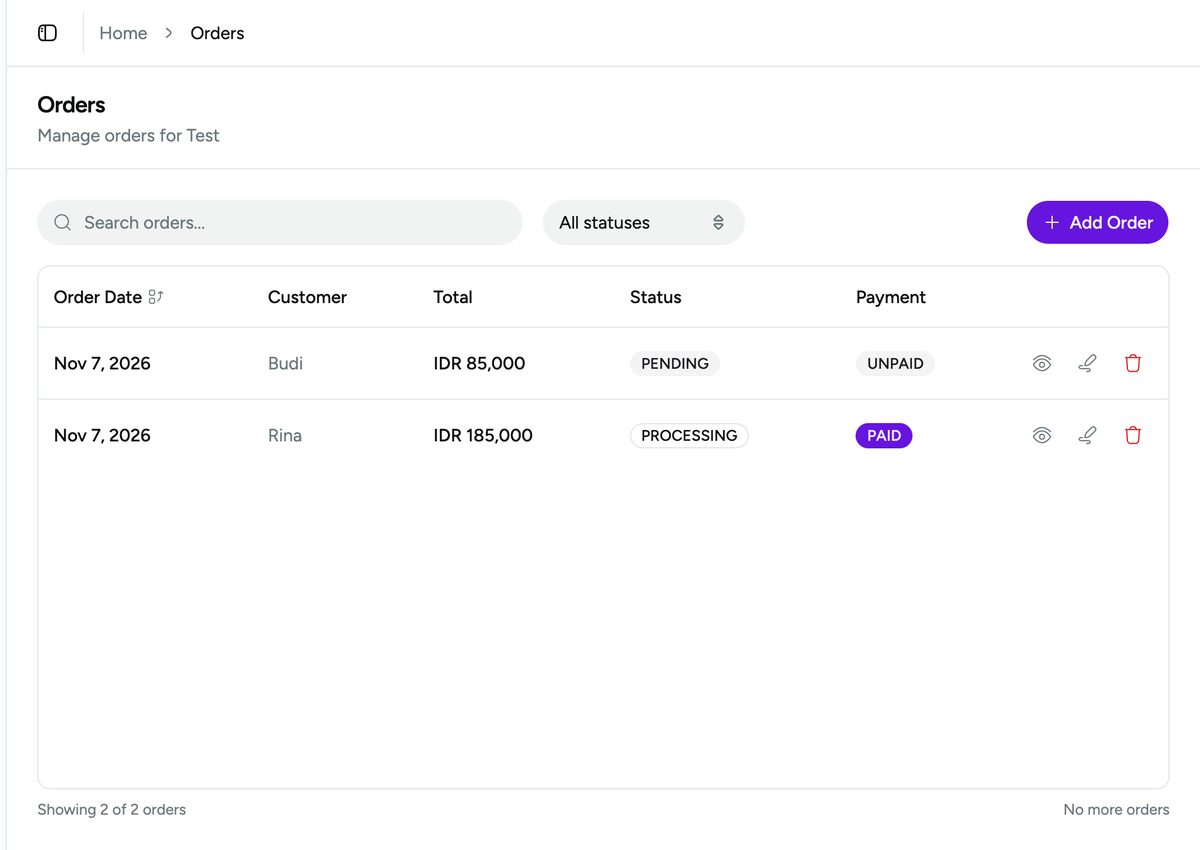 Every order the assistant takes lands as a row like these — viewable, filterable, permanent.
When the assistant later tells you “order #142: 2 pcs black, size L, shipping to Bandung”, that sentence is not a recollection. It is read out of the record — the same table you can open yourself and inspect.
| Chatbot memory (general assistants) | Vio’s approach | |
|---|---|---|
| Where the order lives | In the conversation text | In a database record |
| Long chats | Earlier details drift or vanish | Nothing drifts — records don’t depend on chat length |
| “Order #142 is 2 pcs, size L” | The model believes it from context | The system reads it from the record |
| Fixing a mistake | Re-narrate; hope the model updates | Edit the field in the orders list |
| After the chat is deleted | Record gone | Record intact |
| Auditing | Nothing to audit | Full list, statuses, customers, timestamps |
A traditional app, with a conversational UI
That’s the design in one line: you get the reliability of the app model and the speed of chat at the same time.
For your daily operations, that means:
- Nothing is trapped in a scrollback. Orders, customers, and products each have their own page. You can always check what the assistant actually recorded — like creating and reviewing an order in the back office.
- Mistakes are one click to fix. If a field is wrong, edit the record. You’re not apologizing to a model and asking it to “remember to fix it.”
- Your whole team sees the same truth. Orders are workspace records, not private chats — so the person packing and the person chasing payments work from the same list, not three different recollections.
- The assistant gets smarter about your data without owning it. Business context and skills shape how it works with your records; the records themselves stay yours. (More on how that layering works in teach your assistant your business.)
Where mistakes can still happen — honestly
We won’t pretend the word “AI” comes with zero error. The database eliminates the memory problem, but the assistant still has to interpret what a buyer wrote, and buyers are chaotic:
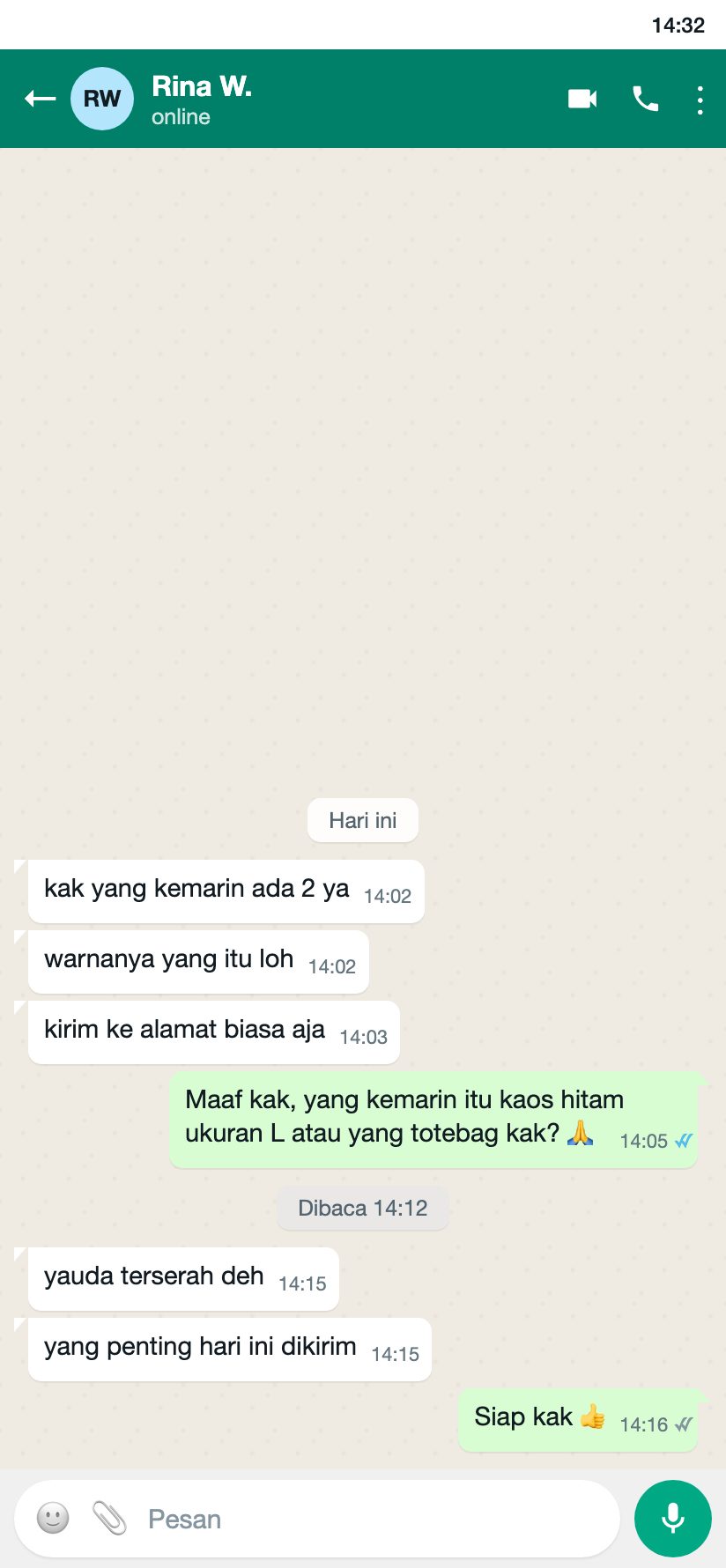 “Kak jadi yg hitam ya 1 aja eh 2” — chat like this is where quantity mistakes are born.
A vague message (“the usual”, “make it two, or one?”) can be recorded with a reasonable-but-wrong guess. That’s not a hallucinated record — it’s a correct record of a misread input, and it’s fixed at the input layer, not the storage layer:
- Give buyers a format. Our copy-paste order templates remove most of the ambiguity before a message even arrives.
- Confirm before you ship. A confirmation reply catches a misread quantity while it still costs nothing.
- Glance at the record. Because every order lands in a visible list, checking what the assistant took is a one-second job — not archaeology through 300 chats. That daily habit is exactly what recording WhatsApp orders properly walks you through, and it closes the leaks listed in 7 online shop admin mistakes.
Frequently Asked Questions
Is Vio just ChatGPT connected to my store?
No. Vio’s assistants use language models to understand you, but orders, customers, and products are stored as structured database records through Vio’s system — not kept in a model’s conversation memory. When the assistant reports an order, it reads the record.
Why does ChatGPT forget previous messages?
Long conversations exceed the model’s context window, so earlier messages get summarized or dropped entirely — a summary is a paraphrase, and paraphrases drift. That’s structural, not a bug you can prompt away, and it’s exactly why orders shouldn’t live in conversation text.
Can the AI still get an order wrong?
It can misread an ambiguous message and record the wrong quantity — you’ll see the record it created and can edit it in seconds. What it can’t do is “forget” or silently invent an order later, because the assistant doesn’t hold the order; the database does.
Why is saving orders in a database better than AI memory?
Because a record is explicit: it can be viewed, searched, edited, filtered, and reconciled. Conversation memory is implicit text that drifts with chat length, survives no thread reset, and offers nothing to audit.
What happens to my orders if I delete the chat?
Nothing. Orders are workspace records, independent of any chat thread. The conversation is just the window you used to create them.
Does this work the same on Telegram and WhatsApp?
Yes. The channel is the surface; the database behind your workspace is shared. Running your back office from WhatsApp uses the same records your Telegram assistant writes to.
The takeaway
- Hallucination in order-taking is mostly an architecture problem: asking a text generator to be your filing cabinet.
- Vio stores every order as a real database record — chat to operate, tables to verify, edit, and audit.
- Remaining risk lives in interpreting messy buyer messages, and that’s solved with templates, confirmations, and a visible order list.
If “what if it gets my orders wrong?” is the reason you haven’t tried an AI assistant for your shop yet — that’s the right question. Try recording a real order and opening it in the orders list yourself. You’ll see the answer isn’t the model’s memory. It’s a row you can click.
Start with Vio free → — no credit card; the free tier covers up to 100 orders so you can judge reliability on your own chats.


0 Comments
Join the conversation